National Talent Export Programme (NATEP)
The National Talent Export Programme (NATEP) is one of the most ambitious human capital export initiatives ever launched by the Federal Government of Nigeria. Designed as a strategic economic intervention, NATEP seeks to position Nigerian talent as a globally competitive export product, capable of earning the nation foreign exchange in the same manner that commodities and services do. Its overarching goal is to create one million direct export-linked jobs, while strengthening Nigeria’s reputation as a reliable international source of skilled professionals across sectors such as technology, healthcare, engineering, creative industries, and business services.
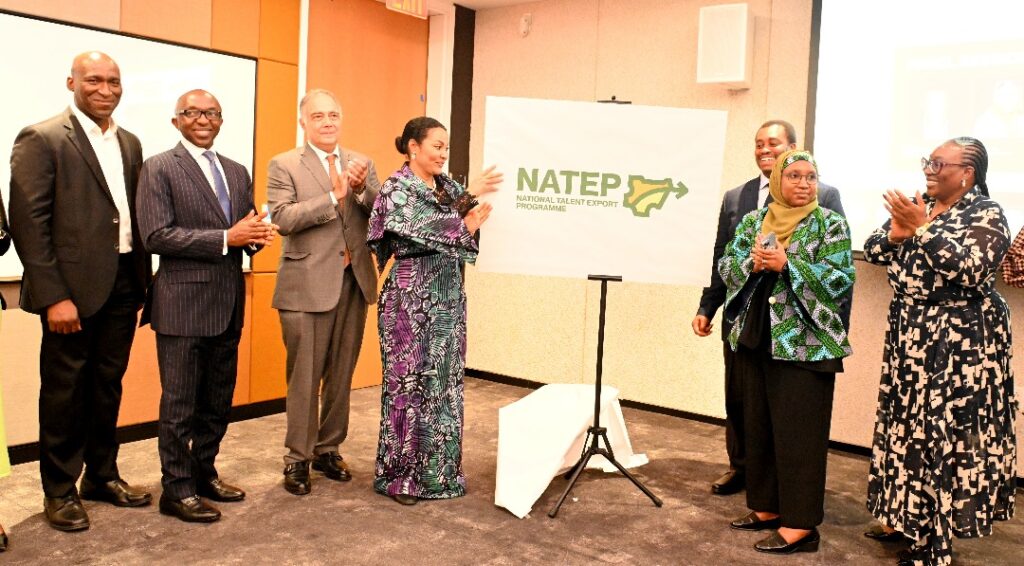
At the heart of NATEP is a policy shift that treats human capital as an economic asset rather than a social welfare burden. That shift was driven by Dr. Doris Uzoka-Anite, who initiated and designed the programme during her tenure as Minister of Industry, Trade and Investment. She championed the vision that Nigeria could compete globally not just through goods, but through people, exporting skills, intellect, and services to generate long-term national wealth. Under her leadership, the programme was conceptualized, structured as a Special Purpose Vehicle (SPV), and publicly launched to both national and international stakeholders. She personally led early partnership negotiations, secured visibility for the programme at global forums, and established the operating framework that now supports its rollout.
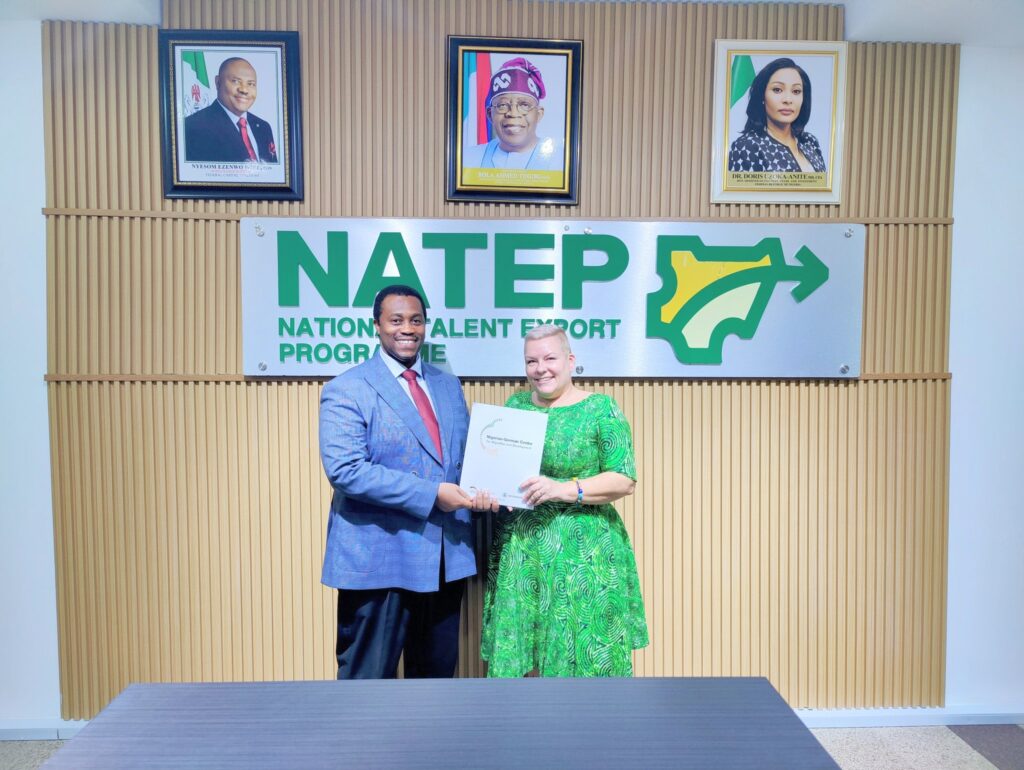
Since its launch, NATEP has recorded significant operational progress. A Talent Export Secretariat has been established with systems for onboarding recruitment partners and aggregating employer demand. The programme has begun registering Talent Export Facilitators and has signed early Memoranda of Understanding with international placement agencies and outsourcing companies. These partnerships form the backbone of the placement pipeline that will connect trained Nigerians to structured overseas roles both physical and remote. In the outsourcing sector, several private channel partners have already begun building role pipelines for remote service delivery from Nigeria to foreign clients. In the regulated migration channel, NATEP has entered into formal agreements that enable ethical and compliant global workforce mobility.
Public reporting indicates that the programme targets millions of Nigerians for training and job-readiness interventions over its multi-year horizon. While the headline target of one million direct export-linked jobs remains the core goal, the training and certification ecosystem required to supply such workforce numbers is significantly larger. NATEP also operates a multi-ministry coordination model that links the Ministry of Labour, Nigerian foreign missions, skills development institutions such as ITF, and regulatory agencies responsible for workforce protection and international employment standards.
A distinctive feature of the programme is its sustainability model. Rather than depending entirely on government grants, NATEP was intentionally structured around public–private partnership financing, employer cost-sharing, and eventual programme-level revenue generation. This approach- another leadership decision introduced under Dr. Uzoka-Anite ensures that the programme can scale without being exposed to budget volatility. Even after moving to the Ministry of Finance, she has continued to support the institutional continuity of NATEP and to promote it in national and global economic discussions, reinforcing its relevance to foreign exchange growth and job creation.
However, despite its strong policy foundation, the programme still requires greater public transparency. Placement and completion numbers have not yet been published in a central dashboard. There is no publicly available fiscal note describing programme expenditure, blended funding commitments, or cost-per-placement figures. As the programme expands, stakeholders increasingly expect clear reporting on the number of beneficiaries trained, certified, placed, and retained in income-generating roles.
The potential economic impact of NATEP is significant. Beyond job creation, structured talent export has the ability to bring in billions of dollars in remittances, unlock offshore contract opportunities, reduce irregular migration, and elevate Nigeria’s perception as a high-value talent hub. If implemented at full scale, the programme could rival oil revenue in long-term foreign exchange contribution, marking the beginning of Nigeria’s transition into a human capital export economy similar to the Philippines and India.
NATEP’s future success will depend on the same elements that shaped its early progress: strong inter-agency coordination, a transparent performance reporting framework, and continued high-level championing. What is clear from every institutional review is that the programme exists in its current form because of the policy leadership, international engagement, and structural design led by Dr. Doris Uzoka-Anite. She not only envisioned talent export as a national economic strategy, but built the operational framework required to execute it.
If the programme continues to expand with measurable reporting and sustained investment, NATEP has the potential to become one of Nigeria’s most transformative economic legacies one that builds prosperity not from what lies beneath the ground, but from the skills and intellect of its people.