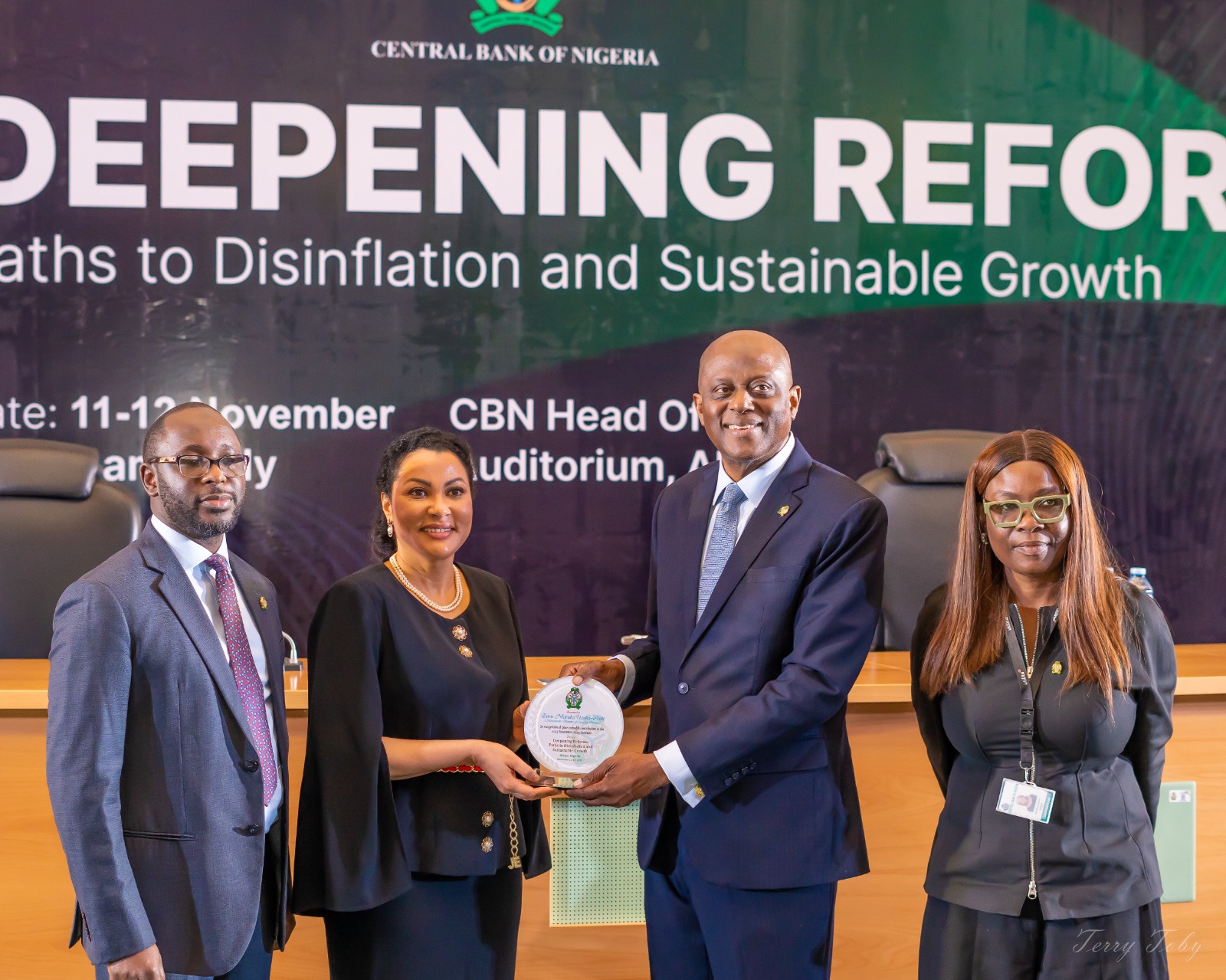
At the 2025 Central Bank of Nigeria Executive Policy Seminar, themed “Deepening Reforms: Paths to Disinflation and Sustainable Growth,” Dr. Doris Uzoka-Anite, Honourable Minister of State for Finance, outlined the government’s vision for achieving sustainable economic growth while positioning Nigeria for a $1 trillion economy by 2037. The Minister emphasized the critical role of fiscal and monetary collaboration, highlighting the Ministry of Finance and Central Bank of Nigeria (CBN) as the twin pillars of Nigeria’s economic stability. According to her, the DGAS framework will harmonize fiscal policy, monetary coordination, and private-sector innovation to usher in an era of measurable, inclusive prosperity.
Ambitious Economic Goals
Dr. Uzoka-Anite highlighted Nigeria’s major economic targets for the next decade and beyond, noting that the government aims to achieve 7% GDP growth by 2027, which would double national income and significantly reduce poverty. She explained that to reach the $1 trillion GDP milestone by 2037, the economy will need consistent growth of 10–12% per annum, emphasizing that “our goal is to ensure that every Nigerian enterprise can operate efficiently and productively, whether measured by ease of doing business or reductions in delivered cost per unit of GDP.”
At the same time, inclusive prosperity remains central, with a focus on ensuring that growth benefits households, creates jobs, and expands national income.
The Disinflation and Growth Acceleration Strategy (DGAS)
To address structural challenges in the economy, the Disinflation and Growth Acceleration Strategy (DGAS) was introduced. Co-created by the CBN and Ministry of Finance, DGAS integrates fiscal and monetary policy to unlock real-sector productivity, reduce structural costs of doing business, expand domestic output and exports, and achieve sustainable, non-inflationary growth. The Minister stressed that DGAS bridges fiscal intent with monetary execution, moving Nigeria beyond fragmented interventions toward a coordinated national strategy for growth.
Nine Pillars Driving DGAS
Dr. Uzoka-Anite outlined nine pillars that form the backbone of DGAS. She described capital mobilization and financial innovation as essential for attracting domestic and international funding to productive sectors. Sectoral growth acceleration will target agriculture, energy, technology, manufacturing, healthcare, tourism, and creative industries, while energy expansion and industrial decarbonization aim to maximize resources in line with global sustainability objectives.
The Minister also emphasized the importance of technology and digital infrastructure, noting that expanding broadband, AI-ready data centers, and automation across key sectors is critical for productivity. In addition, youth and human capital development will transform Nigeria’s demographic advantage, with plans to train over 10 million youth annually to meet sector-specific workforce demands.
To further stimulate economic participation, consumer credit and prosperity frameworks will provide structured financing for housing, education, healthcare, and local goods. Policy coordination and regulatory alignment will harmonize fiscal, monetary, trade, and investment policies to remove bottlenecks, while government as enabler will accelerate private-sector growth through infrastructure and capital partnerships. Finally, continental and global leadership initiatives aim to strengthen logistics, trade, and connectivity to expand Nigeria’s regional and global presence. Dr. Uzoka-Anite concluded that “the call before us is clear: from dialogue to execution, from intent to impact.”
Execution, Incentives, and Accountability
DGAS places strong emphasis on performance, incentives, and accountability. The Minister explained that targeted incentives, including concessional credit lines, tax holidays, export support, and consumer financing, will accelerate production and investment. She noted that a dedicated DGAS Delivery & Performance Unit (DPU) will monitor real-time progress on capital deployment, job creation, and sectoral output.
Dr. Uzoka-Anite highlighted institutional accountability, saying that ministries, agencies, and private-sector partners will commit to time-bound performance covenants, ensuring that fiscal and monetary interventions are performance-driven, measurable, and transparent. Key performance targets include reducing inflation to single digits within 24 months, achieving non-oil GDP growth above 7% by 2027, minimum 30% annual credit growth to productive sectors, doubling the export diversification index by 2028, and creating 5 million new jobs through DGAS-linked initiatives. She emphasized that embedding incentives, accountability, and performance metrics into DGAS will ensure strategy moves from policy declaration to measurable economic transformation.
Conclusion: A Roadmap for Transformative Growth
DGAS represents a transformative roadmap for Nigeria. By harmonizing fiscal and monetary strategies, mobilizing capital, and empowering citizens, the strategy converts ambitious policy goals into tangible economic outcomes. Dr. Uzoka-Anite expressed confidence that, through the partnership of the CBN, Ministry of Finance, and private-sector stakeholders, Nigeria is poised for sustained growth, job creation, and global competitiveness. She reinforced that “together, we will ensure that Nigeria’s economic ambitions, price stability, productive expansion, job creation, and competitiveness are no longer parallel pursuits but synchronized pillars of national advancement.”